
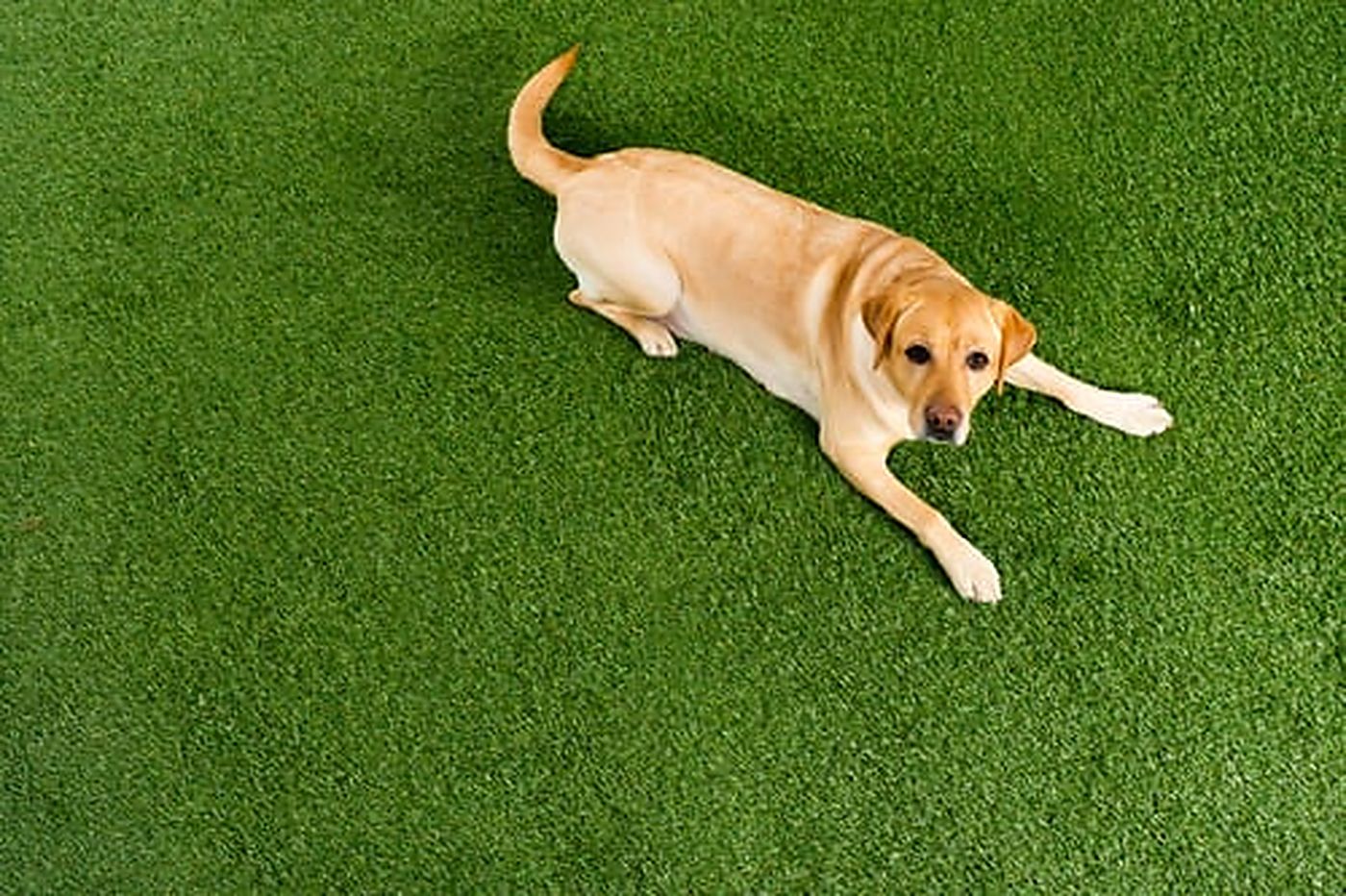
Our logo has a golden retriever on it for a reason. Dogs are the toughest test any lawn gets, and they are the reason a lot of Southern California families give up on natural grass in the first place — the yellow spots, the muddy paws, the trenches along the fence line.
Turf solves all of that, but only if it is specified and installed for pets from the start.
Drainage is the whole game
Pet turf lives or dies on how fast liquid leaves the surface. That means fully perforated backing rather than hole-punched-at-intervals backing, and a base built from material that drains instead of holding water.
If liquid sits in the base, bacteria multiply and odor becomes permanent. If it drains through and away, odor never gets established.
Infill choice matters more than turf choice
Standard silica sand works fine for lawns without pets. For dog households, antimicrobial-coated infill actively suppresses the bacteria that create ammonia smell, and it is worth the modest upgrade cost.
Skip crumb rubber in pet areas. It holds heat and holds odor.
Dig-proof edges
Determined diggers go for the perimeter first — along the fence, at the corner of the patio, anywhere they can get a claw under an edge. Turf that is only glued at the edges will not survive that.
We secure perimeters mechanically to bender board or hardscape and use tighter fastener spacing in known problem zones. It is a small detail that prevents a very annoying repair.
- Mechanically fastened perimeter, not glue alone
- Tighter nail spacing along fence lines and corners
- Bender board or hardscape edge on every boundary
Heat and comfort
Turf warms in direct sun. Dogs will tell you about it before you notice. Lighter blade colors, cooling infill and a quick hose-down before afternoon play all help, and any shaded area of the yard stays comfortable regardless.
Give your dog a shaded spot to retreat to and the heat question mostly takes care of itself.
The maintenance rhythm
Rinse the pet zone weekly. Apply an enzyme treatment monthly through the warm months. Book a professional deep clean once or twice a year depending on how many dogs share the yard.
Households that follow that rhythm essentially never have an odor problem.